Mountain cedar allergy, better known as cedar fever, is a winter pollen allergy centered on Central Texas. The source is Ashe juniper (Juniperus ashei). Texas A&M Forest Service reports that the trees start producing pollen in mid-December, reach a peak in mid-January, and taper off toward the beginning of March.
That timing is what confuses people. Mountain cedar peaks during cold and flu season, so a runny nose in January can be hard to place. A 2000 study of conifer pollens by Schwietz and colleagues named mountain cedar the leading cause of respiratory allergy in South Texas.
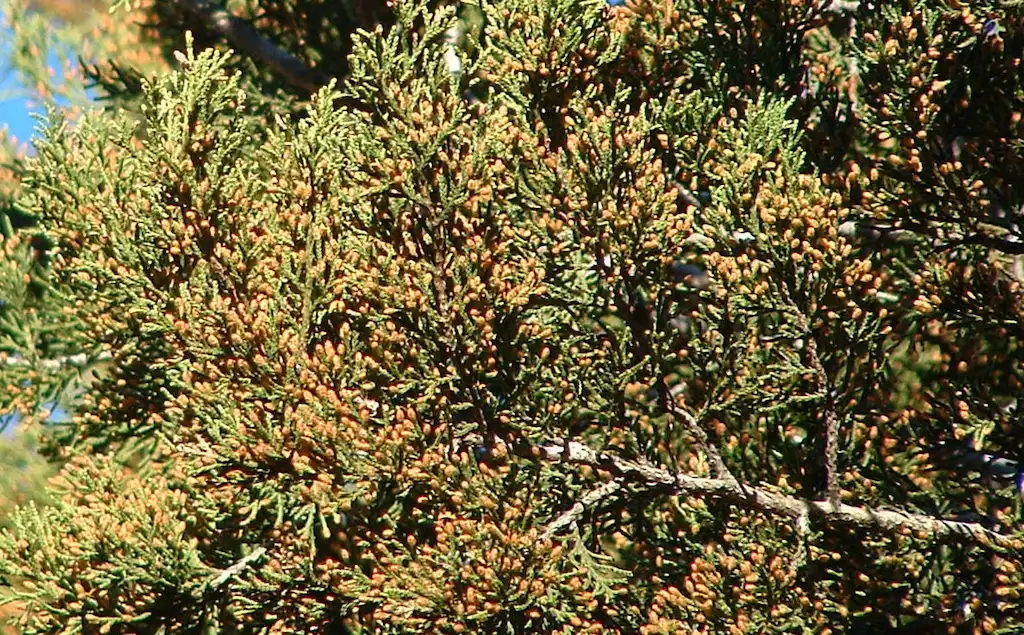
| Scientific name | Juniperus ashei |
| Family | Cupressaceae (cypress family) |
| Type | Tree |
| Pollination | Wind |
| Where it grows | West-central Texas, southern Oklahoma, Arkansas, southwestern Missouri, northern Mexico |
| Peak months | Mid-January; season runs mid-December to early March |
| Allergenicity | Leading cause of respiratory allergy in South Texas (2000 study) |
| Cross-reacts with | Other cypress-family pollens, Japanese cedar |
| Tracker signal | Tree bar |
Quick answer
Mountain cedar pollen causes the seasonal allergy known as cedar fever. The tree grows mainly on the Edwards Plateau in west-central Texas, with smaller populations in Oklahoma, Arkansas, Missouri, and northern Mexico. Pollen usually runs from mid-December to the beginning of March and peaks in mid-January.
Where mountain cedar grows
Ashe juniper has a limited range, according to the USDA Forest Service species review (Sullivan, 1993). The main population sits in west-central Texas, largely on the Edwards Plateau, usually on shallow limestone soils. That historical review gives an estimate of 8.6 million acres in Texas and 0.5 million in southern Oklahoma, and says the tree has spread onto adjacent grasslands.
| Region | Where you find it | Native, planted, or invasive |
|---|---|---|
| West-central Texas | Edwards Plateau, the main population | Native, has spread onto nearby grassland |
| Southern Oklahoma | Arbuckle Mountains | Native |
| Arkansas and southwestern Missouri | Separate, scattered populations | Native |
| Coahuila, Mexico | Separate, scattered populations | Native |
Texas A&M Forest Service says the pollen can blow for miles and is especially irritating in the Hill Country west of I-35.
How far the pollen travels
Living outside that range does not put you out of reach. A 2017 PLOS ONE study by Mohanty and colleagues places Tulsa about 140 miles from the Arbuckle Mountains population and 500 miles from Central Texas, and used DNA testing to confirm Ashe juniper pollen in Tulsa air in January 2014. The same study confirmed 12 grains collected in London, Ontario, on January 15, 2014, more than 1,200 miles from the source. Twelve grains shows how far the pollen can go, not that it causes symptoms there. Both cities appear on our US and Canada pollen pages.
When mountain cedar pollen peaks
Cold fronts set the timing. Texas A&M Forest Service (2024) says the very dry, windy conditions and rapid pressure changes of a front trigger the cones to open. The day’s weather then decides how much pollen gets out. A 2002 American Meteorological Society conference paper by Levetin and colleagues lists the conditions for release from mature cones as air above 45°F and relative humidity below 50%, helped by sunshine and no rain in the previous 24 hours.
| Forecast release conditions | Mean airborne pollen (grains per cubic meter) |
|---|---|
| Unfavorable | 239 |
| Mixed | Mixed |
| Favorable | 1,075 |
Those means come from two trap sites on the Edwards Plateau across the 1998 to 2001 seasons. Favorable days averaged about 4.5 times the pollen of unfavorable days, so a dry, sunny day near a cold front deserves more caution than a wet one. Dates below are for Central Texas and shift each year.
| Stage | Usual timing | What happens |
|---|---|---|
| Start | Mid-December | Colder weather or a cold front starts pollen production |
| Peak | Mid-January | Pollen output is at its highes |
| Decline | Toward the beginning of March | Pollen output slowly tapers off |
Allergies mountain cedar can cause
A mountain cedar allergy shows up as hay fever, known medically as seasonal allergic rhinitis. Texas A&M Forest Service points to the sheer quantity and density of Ashe junipers in Central Texas, all producing pollen at once, as the reason the reaction is so widespread.
Common symptoms
These combine the hay fever symptoms listed by MedlinePlus and those Texas A&M Forest Service reports for cedar fever:
- Runny or stuffy nose and sneezing
- Itchy nose, eyes, or throat, and watery eyes
- Sore throat and fatigue
- Partial loss of smell
- A slight fever in some people
Cross-reactions
Mountain cedar shares allergens with its relatives. Schwietz and colleagues (2000) skin tested ten patients with mountain cedar allergy and found reactions to all 12 cypress-family pollens tested and to Japanese cedar, but not to pine-family pollen. Eastern redcedar matters most in practice. Texas A&M Forest Service says it pollinates around the same time in eastern Texas and can induce a similar response.
How to identify mountain cedar
The USDA review describes a small evergreen tree or shrub, usually with many stems and rarely over 30 feet tall, with thin, shreddy bark. Only male trees release pollen, according to Texas A&M Forest Service.
Eastern redcedar overlaps with it in places, and the USDA review notes trees with in-between features, so the two can be hard to tell apart.
Mountain cedar on the tracker
Mountain cedar counts toward the tree bar, which shows Google’s Universal Pollen Index (UPI) out of 5. Tree pollen appears as one level, so a high reading does not name the species. MyPollenIQ shows a modeled pollen level, not a measured count from a pollen trap.
The PollenIQ score has a known limit during cedar season. It applies a fixed seasonal multiplier of 0.85 in December and January in every US city. Take an example day with tree pollen at 5 out of 5, grass and weeds at 0, and a reading of 70 on Google’s Universal Air Quality Index. That day scores 51, Moderate, in January. The same inputs score 68, High, in April. During cedar season, read the tree bar first.
Lowering your exposure to mountain cedar pollen
Texas A&M Forest Service suggests these steps for high-pollen days:
- Keep windows and doors closed on high-pollen days
- Limit your time outdoors on those days
- Install higher MERV-rated air filters in home and car HVAC systems, and consider a home air purifier
- Skip removing junipers from your yard for allergy relief. The agency does not recommend it, because the pollen can travel so far
When to see a doctor
MedlinePlus advises contacting a provider if hay fever symptoms are severe, if treatment no longer works, or if symptoms do not respond to treatment. A cold or flu can look similar in January, and Texas A&M Forest Service says a fever above 101.5°F suggests that pollen is not the cause. Ask a doctor or pharmacist before starting any allergy medicine, especially for children, during pregnancy, or alongside other medications.
If you have trouble breathing, wheezing, or chest tightness, contact a doctor or call emergency services.
FAQ
What is cedar fever?
Cedar fever is the common name for an allergic reaction to mountain cedar pollen in Central Texas. It is an allergy, not an infection. Pollen usually peaks around mid-January, according to Texas A&M Forest Service.
When is mountain cedar pollen season?
Mountain cedar usually starts producing pollen in mid-December in Central Texas. Texas A&M Forest Service reports a peak in mid-January and a slow decline toward the beginning of March.
Does cedar fever cause a real fever?
Some people run a slight fever, according to Texas A&M Forest Service. The agency says a fever above 101.5°F suggests that pollen is not the cause, so check with a doctor.
Is mountain cedar a true cedar?
No. Mountain cedar is Ashe juniper (Juniperus ashei), a juniper in the cypress family. The USDA Forest Service lists mountain cedar and rock cedar among its common names, which explains the confusion.
How far can mountain cedar pollen travel?
Researchers have confirmed Ashe juniper pollen in Tulsa, Oklahoma, about 500 miles from Central Texas, and in London, Ontario, more than 1,200 miles from its source, according to a 2017 study in PLOS ONE.
Next step
From early December, check the tree bar for your ZIP code each morning and note the days your symptoms flare. If they follow cold fronts and fade by March, take that record to a doctor or allergist, who can test whether mountain cedar is the cause.
Sources
- Sullivan, J. Juniperus ashei. USDA Forest Service, Fire Effects Information System, 1993
- Texas A&M Forest Service. Cedar fever season begins in Texas, December 10, 2024
- Levetin, E., et al. Pollen forecasting: the melding of aerobiology, plant phenology, and meteorology. American Meteorological Society, 2002
- Mohanty, R. P., et al. Molecular analysis confirms the long-distance transport of Juniperus ashei pollen. PLOS ONE 12(3), 2017
- Schwietz, L. A., et al. Cross-reactivity among conifer pollens. Annals of Allergy, Asthma and Immunology 84(1), 2000
- MedlinePlus. Allergic rhinitis
About this article. Written by Anurag P., who built MyPollenIQ. Health and pollen facts are checked against the government, medical, and scientific sources linked in the article. Last updated: November 9, 2026.
MyPollenIQ is for informational purposes only and does not constitute medical advice. Consult a qualified healthcare provider for allergy diagnosis and treatment.